
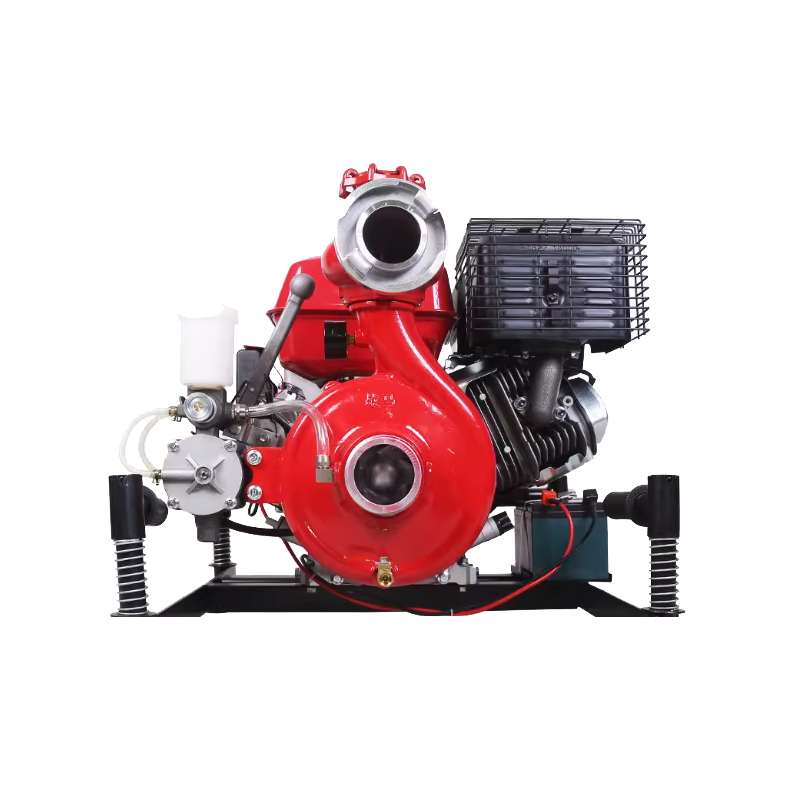
Description
Marine diesel engine emergency fire pump
I. Overview
The CWY type marine diesel engine emergency fire pump is developed in accordance with the provisions of the China Classification Society’s “Rules for Classification of Steel Seagoing Ships – 2006” and the relevant provisions of the “International Treaty on the Safety of Life at Sea.” It is mainly used for emergency firefighting on ships, but is also suitable for industrial and mining enterprises, ports, warehouses, and cargo yards.
This pump set has advantages such as light weight, small size, flexible movement, rapid start-up, fast water output, large fuel tank capacity, corrosion resistance, reliable operation, and convenient maintenance. This pump is available in both manual and electric start versions; users should specify this when ordering.
Pump sets with a diameter of φ40~φ65 are available in both manual and electric start versions. The diesel engine is a vertical, single-cylinder, four-stroke, air-cooled type.
2.Main technical performance parameters:
|
Type |
Capacity m3/h
|
Head m |
Speed r/min |
Suction head
m |
Time of discharge s
|
|
|
65CWY-30 |
25 |
30 |
3500 |
6~7 |
≤35 |
|
|
65CWY-40 |
30 |
40 |
3500 |
6~7 |
≤35 |
|
|
Type
|
Diesel engine |
Weight kg |
Diameter of ischarge mm |
|||
| Type | Power | |||||
|
65CWY-30 |
KM178F 或 KM186F | 4/5.7 | 98/83 |
65/50 |
||
| 65CWY-40 | KM186F | 5.7 | 100/85 |
65/50 |
||
| The numerator of the weight in the table represents the weight including the battery, and the denominator represents the weight excluding the battery. | ||||||
For a detailed selection guide on marine diesel engine emergency fire pumps, you can systematically consider the following aspects:
I. Clarify Application Conditions and Technical Specifications
Purpose and Function
Marine diesel engine emergency fire pumps are primarily used for emergency water supply during ship fires, ensuring the fire protection system’s pressure and flow meet firefighting requirements. They must have an independent power source to ensure normal operation even if the main power supply fails.
Compliance with Classification Societies and Relevant Standards
Following the International Maritime Organization (IMO) International Ship Firefighting Code (FSS Code) and relevant standards of major classification societies (CCS, ABS, DNV GL, LR, etc.).
Ensuring the fire pump’s design, manufacture, and testing comply with the International Convention for the Safety of Life at Sea (SOLAS).
Verifying the pump’s performance parameters meet CFVS (Marine Fire Water System) requirements.
II. Key Performance Parameter Selection
Flow Rate (Q)
Determined based on the ship’s fire protection system design flow rate, generally calculated according to the minimum design requirements.
Common emergency fire pump flow rate range: 100-500 m³/h, specific requirements depend on ship type and hull size.
Head (H)
Calculated based on the maximum water pressure of the fire protection system and pipeline losses, generally between 30-140 meters of water column.
The head must meet the minimum pressure and flow rate required to ensure fire water spraying.
Drive Power and Speed
The diesel engine power should be sufficient to meet the requirements for reliable starting and continuous operation under heavy load conditions.
Common engine speeds are generally 1500 rpm or 1800 rpm, and must be matched with the pump.
Pump Performance and Efficiency
Select a high-efficiency impeller structure (such as a multi-stage centrifugal pump) to reduce fuel consumption and operating costs.
The operating point should be close to the pump’s optimal efficiency point (BEP) to ensure long-term stable operation.
III. Diesel Engine Drive System Requirements
Diesel Engine Selection
Use a low-speed or medium-speed diesel engine with a good imported lubrication and cooling system and stable performance.
Prefer models from well-known brands with complete accessories, including emergency start devices.
Equip with auxiliary equipment such as a fuel system, air purifier, and waterproof exhaust system to meet the needs of the marine environment.
Start-up Method
A combination of manual and automatic start-up ensures reliable start-up in emergencies.
Equipped with an electric start system and a manual backup start device.
Fuel Supply System
An independent fuel system, including a fuel tank, fuel pump, and filter, ensures reliable fuel supply.
Equipped with a fuel alarm and fuel consumption monitoring.
IV. Pump Body and Material Selection
Pump Body and Impeller Material
Commonly uses high-strength cast steel and stainless steel to meet long-term corrosion and wear resistance requirements.
Surface treatment is resistant to salt spray corrosion and suitable for marine environments.
Impeller design should prevent debris entanglement to ensure continuous operation.
Sealing System
Emergency fire pumps generally use mechanical seals or packing seals. Sealing materials must be durable and resistant to high temperatures.
The sealing system can adapt to changes in medium temperature to prevent leakage.
V. Structural Design and Installation Requirements
Pump-Unit Integration
The diesel engine and pump should form a compact pump unit to reduce mechanical connection failures.
Equipped with foundation anti-vibration devices to reduce vibration and noise.
Installation Direction and Space
Consider the ship’s engine room layout to ensure easy maintenance and repair, and facilitate daily monitoring.
The installation location facilitates air circulation and heat dissipation, preventing high-temperature environments from affecting diesel engine performance.
Auxiliary Facilities
Equipped with an automated control system, including remote monitoring, safety alarms, and emergency shutdown devices.
Manual operation devices are provided to ensure manual intervention in critical situations.
VI. Reliability and Safety Design
Redundancy Design
Equipped with a backup pump and backup diesel engine to ensure reliable operation of the pump unit in critical situations.
The design should comply with maritime safety zone classifications and fire protection standards.
Fire and Explosion Protection Measures
The diesel engine installation meets explosion-proof requirements and is protected with fire-retardant coatings and flame-retardant materials.
The electrical system is designed according to marine explosion-proof specifications.
Automatic Monitoring and Alarms
Equipped with pressure, water level, temperature, and oil pressure sensors to monitor operating status in real time.
Automatic alarms for abnormalities facilitate timely handling.
VII. Maintenance and After-Sales Service
Ease of Maintenance
The pump unit is designed for easy daily maintenance and repair, and a detailed operation and maintenance manual is provided. Equipped with a spare parts kit for commonly used consumables.
Manufacturer Qualifications and Technical Support
Select a brand manufacturer with the necessary qualifications to manufacture marine emergency fire pumps.
Provide comprehensive training, on-site installation and commissioning, and long-term technical support.
After-sales service agreements can be signed to ensure continuous and stable operation.
八、Typical parameter reference
| parameter | Reference range | illustrate |
|---|---|---|
| flow | 100-500 m³/h | Ship type and fire protection system design related |
| Water pump head | 30-140 m | Pressure to meet actual fire protection needs |
| diesel engine power | 50-300 kW | Matching according to pump requirements |
| rotational speed | 1500~1800 rpm | Standard speed of conventional diesel engines |
| Material | Cast steel or 304/316 stainless steel | Meets the requirements of marine corrosion environment |
| Protection level | IP55 or above | Prevent splashes and dust |
| Certification | CCS/ABS/DNV GL and other classification society certifications | Ensure compliance with international and classification requirements |
IX. Summary and Recommendations
Accurately calculate the required flow rate and head of the fire pumps based on the ship type and fire protection design specifications, allowing for a certain safety margin.
Select pump unit brands approved by classification societies and known for their reliability, ensuring equipment reliability and service life.
Diesel engines should have good starting performance and fuel economy, suitable for the marine environment.
Optimize the installation space layout for convenient daily maintenance and emergency operation.
Improve the control and alarm system to ensure timely response in emergency situations.
Pay attention to after-sales service and spare parts supply to ensure the ship’s fire protection system is always in good standby condition.

Reviews
There are no reviews yet.